

This module provides a guide to writing a business plan for a community organisation considering taking on an asset. It relies on the general principles used when preparing a plan for a new business. We use the term ‘business’ because taking on an asset will require you to adopt a business approach – whether you are a community development trust, charity or any social purpose vehicle.
This module aims to provide an introduction to running an asset effectively post-acquisition. It considers key issues such as premises management, maintenance and use, financial controls and sustainability, risk management, social value and good environmental practice. It relates strongly to the previous modules in this programme, which contain information to ensure that once you take control of the asset, regardless of tenure, you will be in a strong position to manage it successfully.
A briefing for the Scottish Government to inform the review of the Community Empowerment (Scotland) Act; highlighting the experience of community groups going through the asset transfer process, general trends and specific issues that have emerged since the Part 5 Community Asset Transfer went live in January 2017.
Download PDF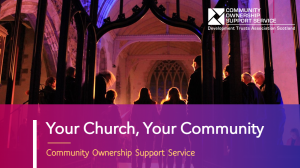
Guidance for communities exploring future uses for church buildings.
This guidance has been developed by the Community Ownership Support Service, Heritage Trust Network and Historic Churches Scotland to meet a growing need from communities for specific guidance around churches and accompanying land.Taking over a building of any type is a big step for a community and brings with it substantial responsibility. It can appear a daunting prospect, but this document has been designed to guide you through the process.
Download PDF
This guidance has been developed by the Community Ownership Support Service, Heritage Trust Network and Historic Churches Scotland to meet a growing need from communities for specific guidance around churches and accompanying land.
Taking over a building of any type is a big step for a community and brings with it substantial responsibility. It can appear a daunting prospect, but this document has been designed to guide you through the process.
Download PDF
Community led action planning is a tried and tested way of setting out a vision for a community with an accompanying set of actions to be delivered over time.
The purpose of this document, having reflected on the history of community action planning, is to set out an ideal process that is effective and will achieve impact, but is also affordable and accessible to local people.
Download PDFThe following webinar will:
– Provide practical solutions to reducing your energy consumption now.
– Give you information on how you can decarbonise your community building and become more energy efficient, including information on the CARES programme.
– Outline what the benefits may be of signing up to the Scottish Government Utilities Framework and how to go about doing that.
Speakers include:
– Ryan Felber – Business Energy Advisor for Business Energy Scotland – Top tips for reducing energy consumption now.
– Mhairi MacSween and Graham McGrath –CARES Development Officers, Local Energy Scotland – how can I decarbonise my community building and make it even more energy efficient.
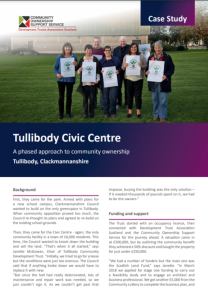
A phased approach to Community Asset Transfer
Download PDF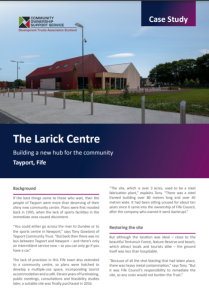
Building a new hub for the community
Download PDF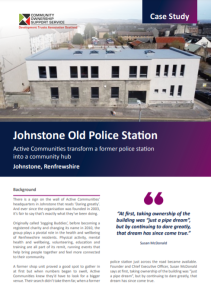
Active Communities transform a former police station into a community hub
Download PDF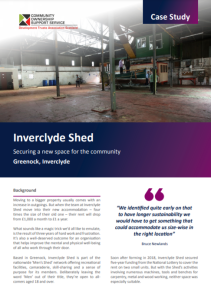
Securing a new space for the community
Download PDF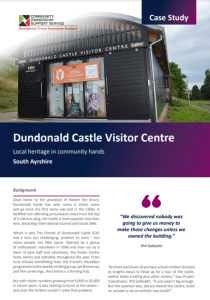
Local heritage in community hands
Download PDF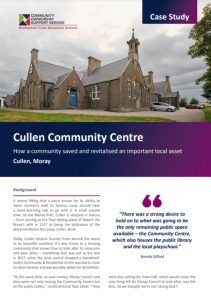
How a community saved and revitalised an important local asset
Download PDF
Provides communities with a introduction to Community Right to Buy. The guidance covers:
- Which CRtB option is most appropriate for your community
- An overview of the three CRtB processes
- Community Right to Buy Part 2
- Community Right to Buy – Abandoned, Neglected or Detrimental Land
- Community Right to Buy – Land to further Sustainable Development
- Getting ready for CRtB
- Four case studies from communities that have used the process
- Tools and resources to help you on your journey
This publication has been produced in response to the concern about the closure of public toilets across the country and the awareness of the need for good public toilets to promote health, access and inclusion. Increasingly communities are looking at how they can become involved in saving or providing public toilets, so here we present some facts and examples of how other communities have gone about saving this service.
Below you will also find the accompanying webinar, delivered by Sandra Macaskill of CaskieCo, who has researched and written the publication for the Community Ownership Support Service, this webinar will draw on the experiences from urban and rural communities, discuss the issues to be considered and highlights some of the innovative approaches being taken.
Please note – this resource was written in 2018 and has not been updated to reflect guidance in relation to Covid-19
Download PDF
COSS Guidance for Relevant Authorities – Managing Risk in Community Asset Transfer
Download PDF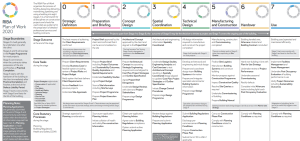
RIBA Plan of Work 2020 Overview
Download PDF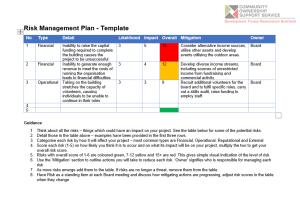
Risk Management Template and Guidance.
Download PDF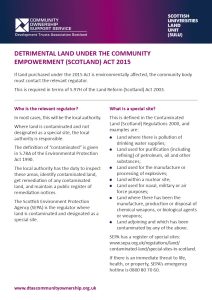
This fact sheet from SULU (Scottish University Land Unit) provides information on detrimental land under the Community Empowerment Act, including what community bodies should do if land purchased under the 2015 Act is environmentally affected.
Please note – This fact sheet is for Scottish property only and contains guidance, not legal advice.
Download PDF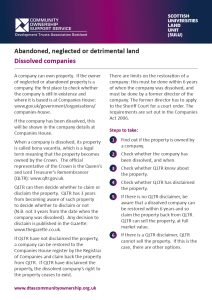
This factsheet from SULU (Scottish Universities Land Unit) provides useful information on abandoned, neglected or detrimental land which is thought to be owned by a dissolved company.
Note: This factsheet is for Scottish property only and contains guidance, not legal advice.
Download PDF